
If you live in the Appalachian mountains, ticks are simply part of the deal. You check your ankles before you come inside. You run your fingers through your kid's hair after a creek walk. You've probably pulled a tick off the dog more times than you can count. And somewhere in the back of your mind, every single time, is the same quiet worry: Lyme.
That fear isn't irrational, and unfortunately it isn't new, though the disease itself wasn't even understood by modern medicine until surprisingly recently.
How we found out what Lyme even was
Lyme disease and ticks have coexisted for thousands of years, but the condition wasn't recognized in the United States until the 1960s and 70s. In 1975, numerous children and adults around Lyme, Connecticut began suffering from puzzling, debilitating symptoms. Arthritic like symptoms in otherwise healthy kids. It was two persistent mothers in that community who refused to let their children's symptoms be dismissed that made all the difference. These mothers who noticed the pattern contacted state public health officials and Yale researchers took notice.
Researchers noticed something interesting: the new illness looked a lot like a known tick-associated skin condition already documented in Europe, which led them to suspect ticks as the source. The similarities between the unknown disease and erythema migrans, already known in Europe and sometimes associated with tick bites, led researchers to hypothesize ticks as the cause of what they initially named "Lyme arthritis." By 1978, researchers had confirmed that deer ticks were in fact transmitting the illness. But the actual culprit (the bacterium itself) wasn't identified until several years later. In 1982, an entomologist named Willy Burgdorfer, while dissecting the midgut of a tiny deer tick, spotted something unexpected under the microscope. Burgdorfer noticed what looked like spirochete bacteria. That bacterium now carries his name: Borrelia burgdorferi.
In the span of human history, Lyme disease is barely a toddler, we've only understood its actual cause for a little over fifty years. That's part of why it still inspires so much fear and so much confusion.
What Lyme actually looks like
Many associate the start of Lyme disease with erythema migrans, the bullseye rash, which occurs in many but not all cases of Lyme disease after being bitten by a tick. Early Lyme more often shows up as something easy to mistake for a summer bug (fatigue, headache, fever, joint and muscle aches) sometimes with no rash at all, or a rash that doesn't look like a target. That's why if you're bitten, the smart move isn't to wait for a bullseye to appear before taking it seriously. It's to watch the site and your overall health for several weeks and loop in a doctor if anything unusual shows up.

Why you should never try to "smother" a tick out
There is one piece of folklore that can genuinely make things worse.
You've probably heard it, dab the tick with petroleum jelly, nail polish, rubbing alcohol, tea tree oil, or even a hot match, and it'll back itself out. It feels intuitive. It's also been tested, and it doesn't work. A study testing petroleum jelly, fingernail polish, 70% isopropyl alcohol, and hot matches found that none of these methods caused attached ticks to detach, even after they'd been attached for days. Worse, irritating a tick this way can actually backfire. Agitating a tick causes a backwash of biological fluids directly into the host's bloodstream.
Ticks are not passive straws. They are active pumps. Once attached through reverse barbs in the host, the tick must manage their fluids in order to continuously feed on their host for several days. This means they act like active pumps and use a cyclical 'suck and spit' routine. They suck blood in, filter out nutrients, and separate excess water and salt. Every few minutes, they pump that excess fluid back into the host via their salivary glands.
When heat, oils, or chemicals are applied to the tick, their nervous system is becoming hyper-stimulated. In their panic, the tick's salivation mechanism goes into overdrive, causing it to rapidly salivate and dump large volumes of fluid back into the host before it detaches.
In other words: smothering doesn't save you time, and it may actively increase your risk.
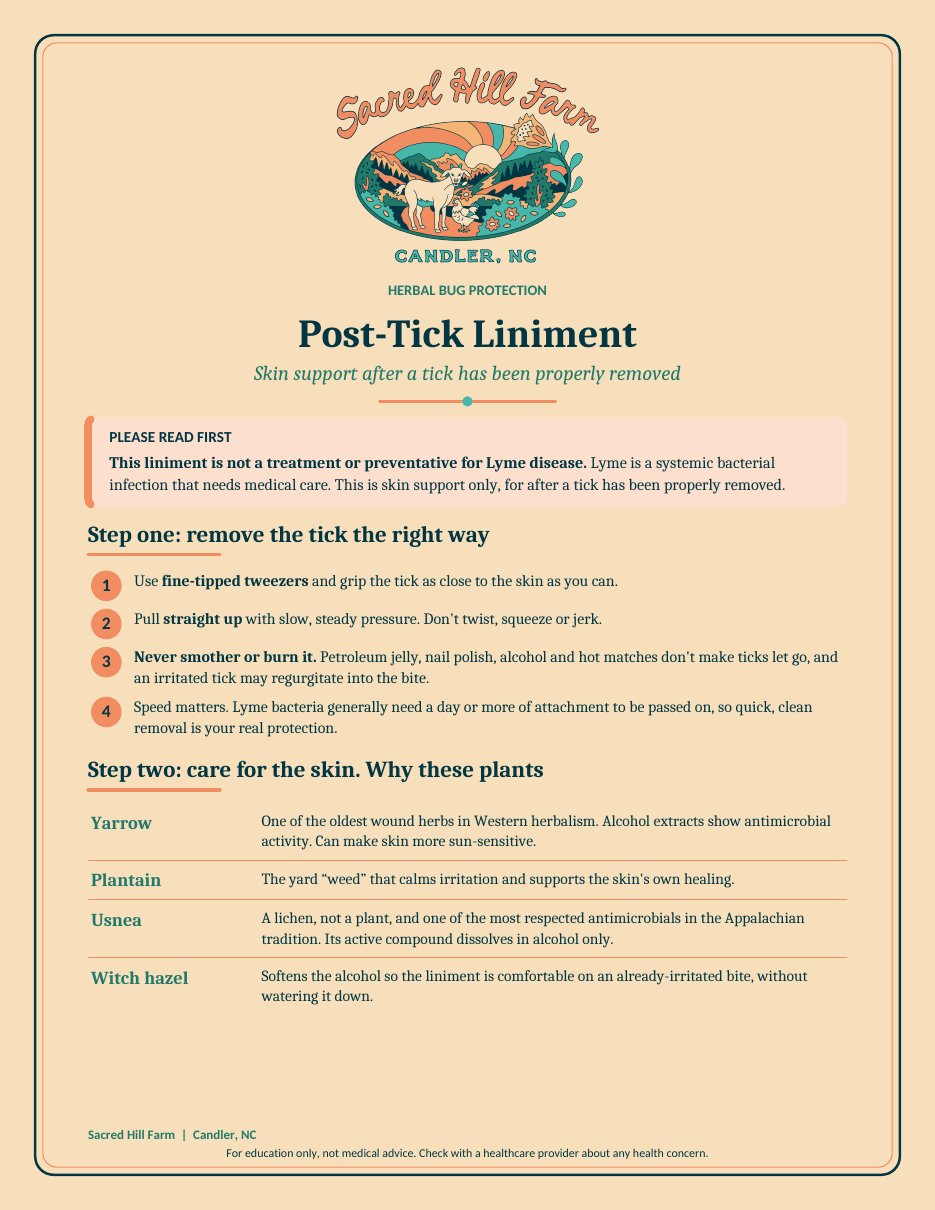
Timing matters too. Experimental studies show no confirmed transmission of Lyme disease from a single infected tick within the first 24 hours of attachment. This means fast, correct removal is genuinely protective. The method that actually works is simple: fine-tipped tweezers, gripped as close to the skin as possible, pulled straight back with slow, steady pressure. No twisting, no squeezing the body, no waiting around for the tick to "let go" on its own.
Where to provide support
Once that tick is out cleanly, quickly, and the right way, there's still a job left to do: taking care of the skin it left behind. I am not talking about a Lyme treatment. Nothing topical treats a systemic bacterial infection. But there is a real and useful ritual that can provide local antimicrobial and anti-inflammatory support, and a built-in reason to actually look closely at that spot every day, which is exactly the habit that helps you catch anything worth calling a doctor about.
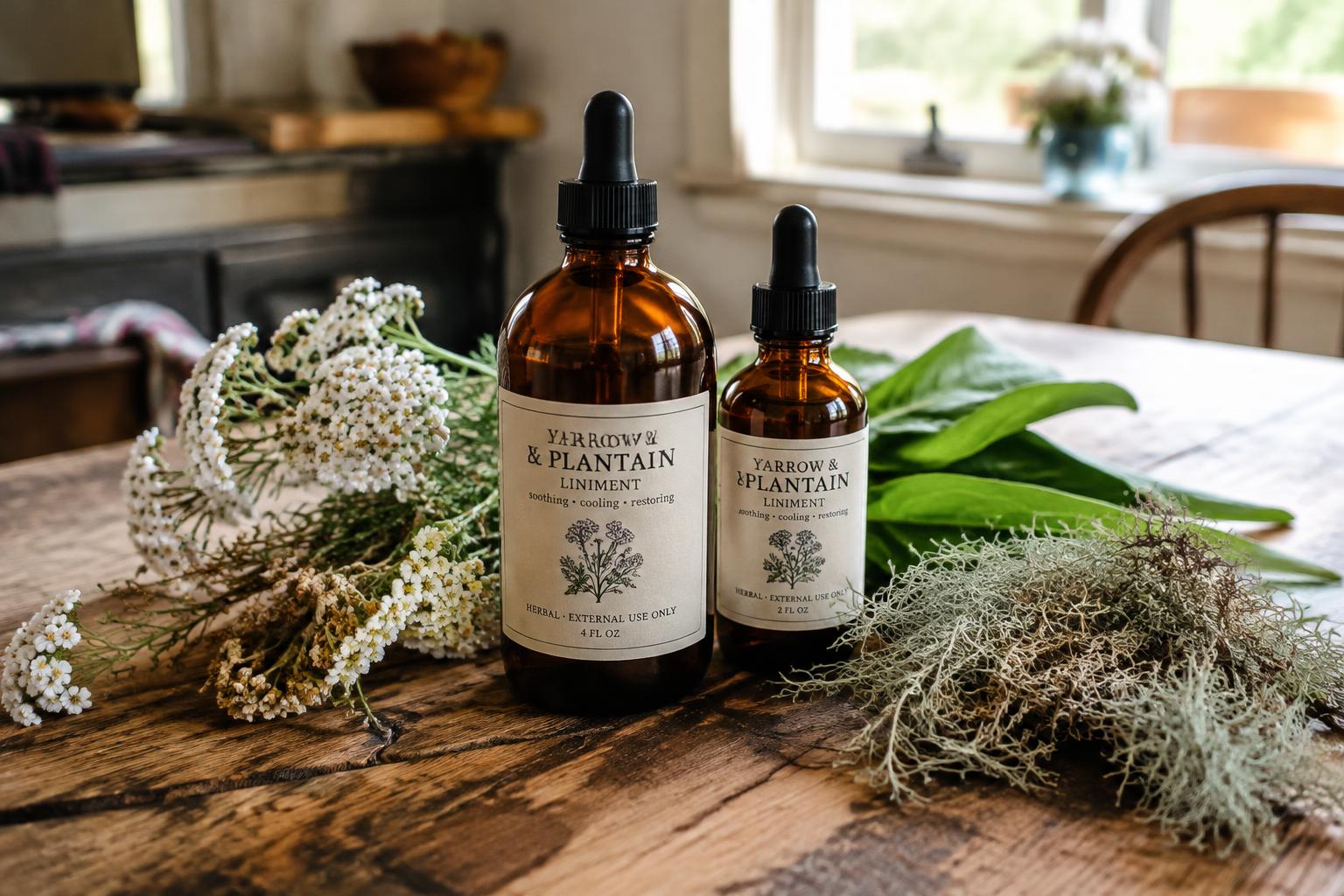
Post-Tick Liniment
A simple, plant-based skin support for after a tick has been properly removed made with 3 Appalachian plants and alcohol.
Why these three plants:
- Yarrow — one of the oldest wound herbs in Western herbalism (its genus name traces back to Achilles, who was said to use it on his soldiers' wounds). Alcohol-extracted yarrow carries real antimicrobial activity. One caution: yarrow can be mildly phototoxic, so keep treated skin out of strong direct sun.
- Plantain — the "weed" in your yard that's quietly one of the best anti-inflammatory, soothing herbs in folk medicine. It calms irritation and supports the skin's own healing response.
- Usnea — technically a lichen, not a plant, and one of the most respected natural antimicrobials in the Appalachian tradition. Its active compound is alcohol-soluble only, which is why it needs a strong, patient extraction (or a gentle, careful heat-assisted shortcut) to pull its full potential.
Optional add-in witch hazel:
Liniments are traditionally alcohol-based. It's what gives this blend its fast-penetrating, antiseptic quality. But a tick bite site is often already a little irritated, so straight tincture-strength alcohol, applied daily, can sting and dry the skin out. Cutting the blend with witch hazel softens the liniment, especially for more sensitive skin.
To make:
Make individual tinctures out of yarrow, plantain and usnea by placing each plant in its own jar and covering with alcohol. A standard vodka will work fine for yarrow and plantain, but usnea needs something stronger like Everclear. Combine your yarrow, plantain, and usnea tinctures in roughly equal parts (or weighted slightly toward usnea). Cut the blend with witch hazel at about 2 parts tincture blend to 1 part witch hazel. Store in a small glass bottle with a dropper or rollerball for controlled, precise application.
To use:
Apply a few drops directly to the cleaned bite site. Patch test on unbroken skin first if you have sensitive skin. Watch the site daily for about 30 days. Any expanding redness, with or without a classic bullseye shape, or flu-like symptoms like fever, fatigue, joint pain, or headache in the weeks that follow, warrant a call to your doctor, regardless of how the skin looks.
This isn't a substitute for medical care. It's a small, grounded ritual with some topical antibacterial support. Plants that have earned their place in this tradition, doing the part that's actually theirs to do.
Resources
-
CDC – Tick Removal guidance: cdc.gov/ticks/animals/removing-a-tick.html
-
JETem (Journal of Education & Teaching in Emergency Medicine), peer-reviewed: "Tick Removal" https://jetem.org/?p=11326
-
Needham GR, "Evaluation of five popular methods for tick removal," Pediatrics, 1985
-
scienceinsights.org https://scienceinsights.org/what-to-put-on-ticks-to-make-them-release/
-
Connecticut Department of Public Health, official state history page — solid primary-source timeline (1975 cluster → 1982 Burgdorfer discovery → 1984 serology testing): https://portal.ct.gov/dph/epidemiology-and-emerging-infections/a-brief-history-of-lyme-disease-in-connecticut
-
Connecticut Historical Society / connecticuthistory.org https://connecticuthistory.org/?p=55868
-
The Boston Globe, "Lyme disease: How we discovered it and where we go from here" https://www.bostonglobe.com/ideas/2019/08/22/lyme-disease-how-discovered-and-where-from-here/KVovTbvJsJ8HIhx4K7yYQI/story.html
-
Bay Area Lyme Foundation https://www.bayarealyme.org/about-lyme/history-lyme-disease/
This is shared from our own experience and isn't medical advice. Check with a healthcare provider before using herbal remedies, especially for children, during pregnancy, or for a suspected tick-borne illness.