
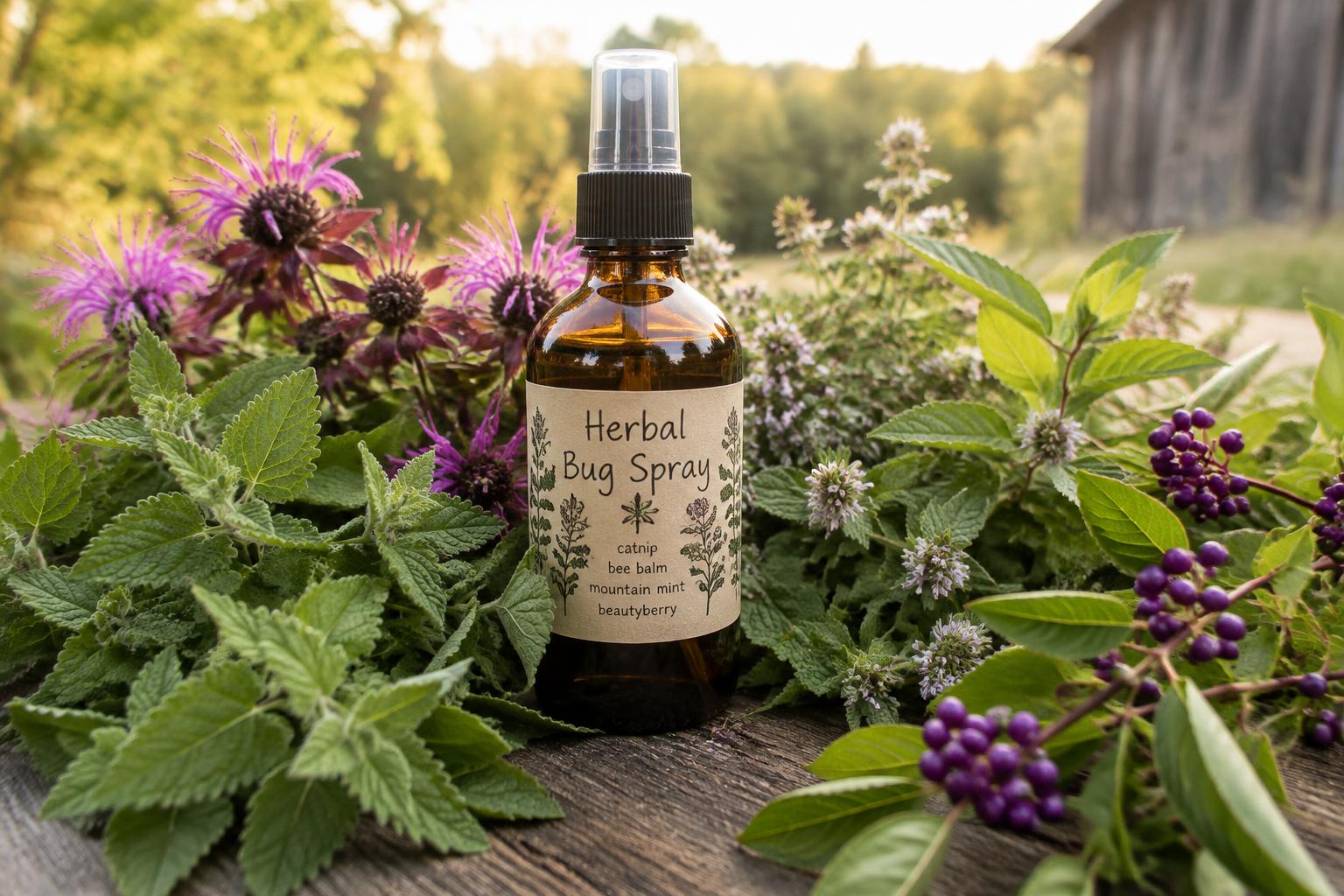
Most people assume "natural" bug repellents are the compromise option: gentler on your skin, but you're trading away real effectiveness to get there. That assumption doesn't hold up nearly as well as people assume, at least not for a few plants that happen to already be common in the Southern Appalachians. There are some powerful bug repelling plants that grow in the Appalachians which can be used to make an excellent bug spray.
Like all beings, plants want to survive. They know how to adapt to their environment and have developed protective mechanisms like bitter flavors, strong aromatics or poisonous constituents that allow them to protect themselves from the things that would like to consume or destroy them, especially bugs. But some are better at it than others. And knowing the constituents and specificities of specific plants allows us to choose the best ones for the job we are looking for. In this case, for a bug repellent!
I use a variety of Appalachian plants when making repellents because they all serve different roles. The combination assists in making a more well-rounded spray. The following are the plants that have shown valuable research and the ones I choose as my go-to for pest control.
The catnip surprise
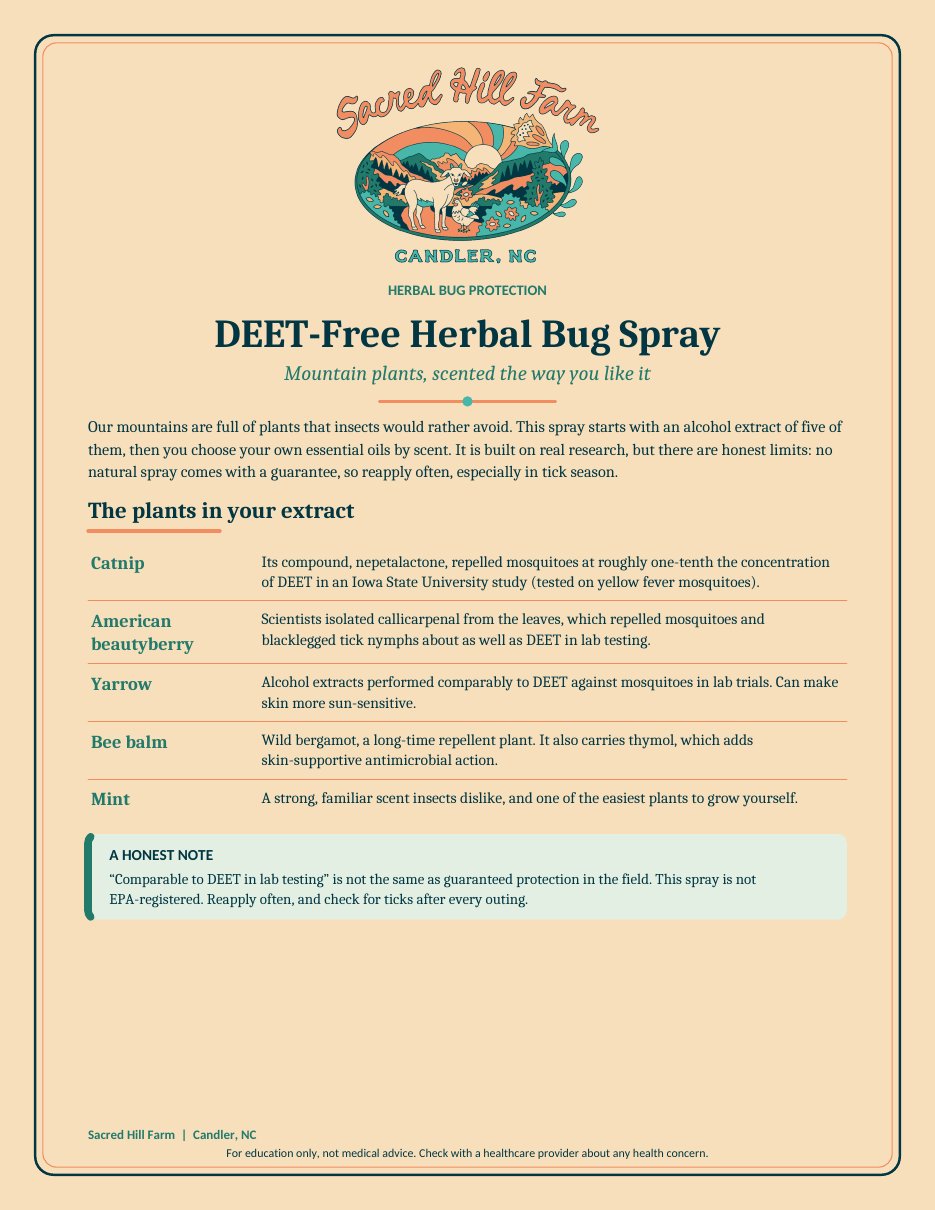
If you've ever watched your cat lose its mind (or completely bliss out) over a sprig of catnip, you already know the plant produces something potent. That same compound (nepetalactone) turns out to be remarkable against mosquitoes too. Researchers at Iowa State University found that nepetalactone works as a mosquito repellent at roughly one-tenth the concentration needed for DEET to have the same effect, making it roughly ten times more effective by that measure. The study tested yellow fever mosquitoes specifically, but the lead researcher expressed confidence it would hold up against other mosquito species as well.

The Lapland tradition that held up under testing
Yarrow doesn't have quite as flashy a research headline, but it's arguably even better documented. Long before anyone was measuring repellency in a lab, Lapland folk tradition used alcohol-extracted yarrow to keep mosquitoes away. When researchers finally tested it directly, they found yarrow extract performed comparably to DEET and a related DEET-analog compound in laboratory trials against mosquitoes, with field testing confirming the effect against several additional species. One honest caveat worth knowing: yarrow can be mildly phototoxic, meaning treated skin may react more readily to strong sun exposure. Worth keeping in mind for a spray used outdoors in daylight.
The folk remedy that USDA scientists almost dismissed
A USDA botanist in Mississippi grew up hearing that his grandfather used to crush American beautyberry leaves and tuck them under the harnesses of farm animals, or rub them on skin, to keep biting insects away. He mentioned it to a colleague, a chemist at the USDA's Agricultural Research Service, who, by his own admission, expected the old folk tale to lead nowhere once put under real scientific scrutiny. It didn't. Researchers isolated three compounds from beautyberry leaves, and one of them, callicarpenal, turned out to repel both mosquitoes and deer tick nymphs about as effectively as DEET. Later testing showed treated strips repelled more than 95 percent of blacklegged tick nymphs, the exact tick species responsible for transmitting Lyme disease in our region. The USDA has since pursued patent protection for the compound, a rare case of grandfather's folklore turning into genuine federal research interest.
Alongside catnip, yarrow, and beautyberry, this blend also includes mountain mint and bee balm (wild bergamot). Both are long-standing repellent plants in their own right, and both easy to grow or forage in this region. Mountain mint (actually all mints) contain strong aromatics like menthol, limonene and pulegone that interfere with the central nervous system. Most insects will avoid pulegone because ingesting or contacting it can be toxic or lethal to them. Bee balm carries thymol, a compound known for its strong antimicrobial properties, which adds a layer of skin-supportive benefit beyond repellency alone. The Monarda fistulosa variety of bee balm is the gentlest on the skin as thymol can be hot.
Creating a spray
This spray starts as a single infused extract. Mint, yarrow, catnip, beautyberry, and bee balm are infused together in alcohol by filling a jar with the wilted plants then covering with alcohol and letting sit for at least 4-6 weeks. After filtering the tincture, choose your own essential oils based on scent preference. Essential oils provide another level of aromatics which are pleasing to us and can add an even additional level of protection depending on what is used. But at this point, I just choose EOs for their smell because I already have a lot of heavy hitters to repel insects. Next, blend them with a small amount of liquid sunflower lecithin (to help the oils stay suspended rather than separating out in the alcoholic tincture), and dilute the whole thing down to a skin-comfortable strength.
Base extract:
Mint, yarrow, catnip, beautyberry, and bee balm, infused in 80-proof (40–45%) alcohol.
Choose your essential oil lane:
- Woodsy: cedarwood, citronella
- Bright/citrus: sweet orange, lemongrass, eucalyptus
- Herbal/floral: lavender, rosemary, geranium (geranium is especially well-regarded for tick repellency specifically)
Emulsifying the EOs:
Combine your chosen essential oils with an equal amount of liquid sunflower lecithin, stir until fully blended, then add to your extract.
Dilution:
Since the base extract is 80 proof, dilute with distilled water at roughly a 2:1 to 3:2 ratio (extract to water). This lands the final product around 27–30% alcohol by volume, which comfortably clears the threshold most herbalists use for a product that stays reasonably shelf-stable, while being far gentler on skin than the straight extract.
To apply:
Shake well before each use (even with the lecithin, some settling is normal), and spray onto skin or clothing as needed, avoiding eyes and broken skin.
A few honest notes
- This is a seasonal product, not a forever-shelf item — treat it as something to make fresh annually rather than something that lasts indefinitely, especially once diluted with water.
- If you included citrus EOs, keep in mind both citrus oils and yarrow carry some phototoxicity risk. Not a reason to avoid them, just something to be aware of with heavy sun exposure.
- No natural repellent, including this one, offers guaranteed protection the way EPA-registered repellents are tested and required to. This blend is built on genuinely promising research, but "comparable to DEET in lab testing" and "guaranteed protection in the field" aren't quite the same claim. Reapply often, especially in high-risk tick season.
This is shared from our own experience and isn't medical advice. Check with a healthcare provider before using herbal remedies, especially for children, during pregnancy, or for a suspected tick-borne illness.