
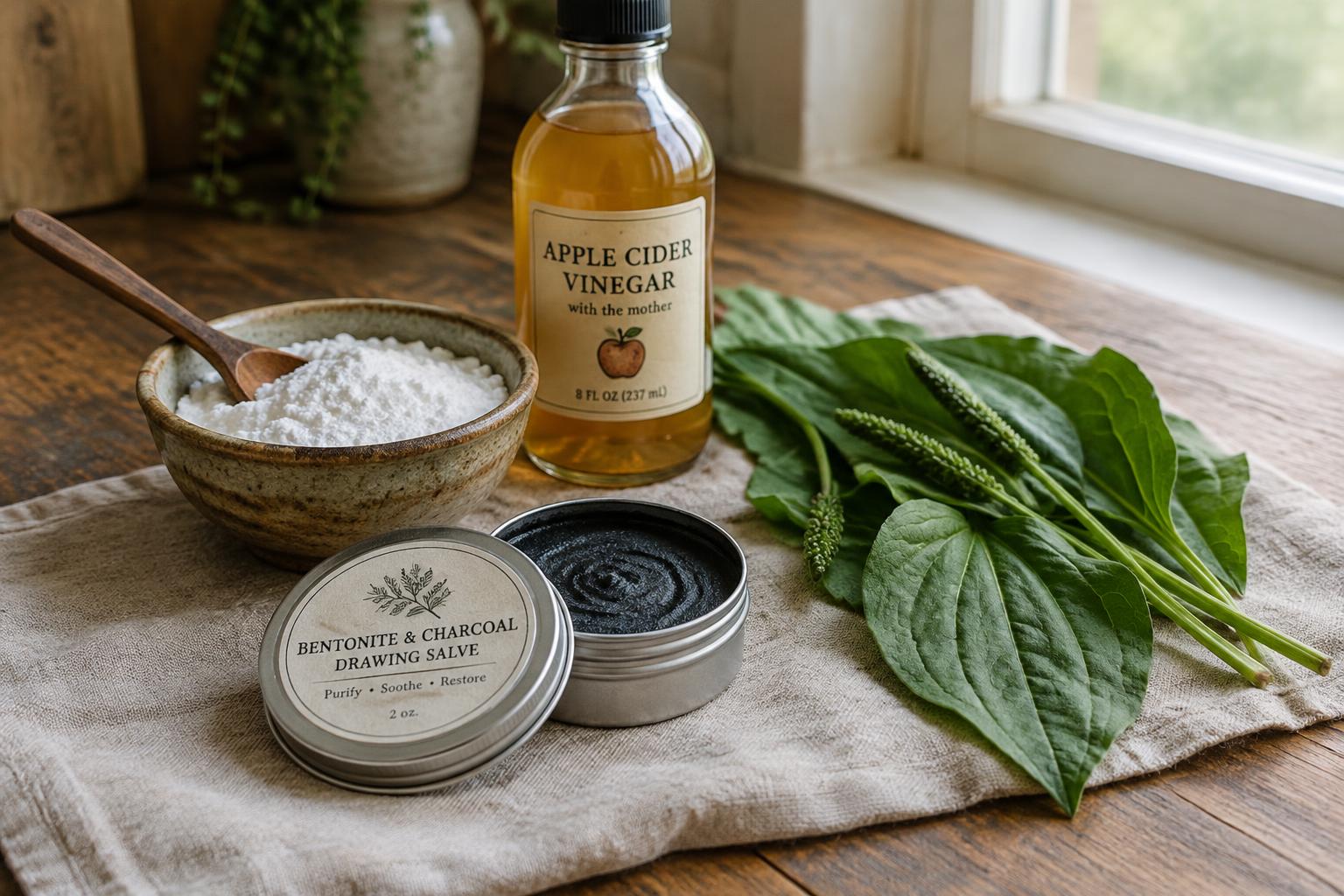
Not all bug encounters are created equal, and neither are the home remedies for them. Bee stings, wasp stings, and mosquito bites each call for a slightly different approach, because the chemistry behind the irritation is actually different in each case. Here's how to tell them apart, what to reach for, and a drawing salve recipe that works as a solid all-purpose option when you're not sure exactly what got you.
Bee stings: reach for baking soda
Bee venom is acidic. Baking soda is alkaline. When you make a paste of baking soda and a little water and apply it to a fresh bee sting, you're directly neutralizing that acidity. It's simple kitchen chemistry. It works best applied soon after the sting, left on for 15–20 minutes.
One practical note: if you've been stung by a honeybee specifically, check for a stinger left behind first (honeybees are the one stinging insect that leaves their stinger in you). Scrape it out sideways with a fingernail or card edge rather than tweezing it, which can squeeze more venom in. Then apply your baking soda paste.
Wasp stings: reach for apple cider vinegar
Wasp venom runs more alkaline, which is the opposite problem. So the fix flips too. A splash of apple cider vinegar on a cotton ball, held against the sting, helps neutralize the alkalinity the same way baking soda neutralizes bee venom. Wasps don't leave a stinger behind, so there's no removal step here. Just apply and let it sit.
Why pH-matching only gets you so far
Both of these are genuinely effective, science-backed quick fixes, but they share a limitation: they only work if you know what stung you, and they're something you mix fresh in the moment. They aren't something you can premake and keep on hand. Most of the time, especially with kids or in the middle of an outdoor activity, you don't actually know whether it was a bee, a wasp, a mosquito, or something else entirely. That's where a general-purpose drawing remedy earns its place.
Mosquito bites, unknown stings, and general irritation: bentonite clay
Bentonite clay doesn't work through pH neutralization. It works through adsorption. The clay's particles carry a negative ionic charge that attracts and binds toxins, irritants, and inflammatory fluid, pulling them up and out of the skin rather than neutralizing them chemically. That makes it less precisely targeted than the pH-matched remedies above, but far more versatile: it doesn't matter whether you know exactly what bit or stung you, because it's addressing the swelling and irritation generally rather than a specific venom chemistry.
This is also why bentonite clay is the better choice for mosquito bites, unidentified stings, and general "something got me and it's itchy and swollen" situations. There's no pH-matching trick for mosquito saliva the way there is for bee or wasp venom, so a drawing approach is really the most useful tool available.
Taking it further: adding activated charcoal
Activated charcoal works on the same adsorptive principle as bentonite clay, just with a different particle structure, and the two are a classic pairing in drawing-salve formulation. Combining them gives you a stronger, more broadly effective drawing action than either ingredient alone, which is exactly what you want in a general, "don't know what bit me" first-aid salve.
Pairing that drawing action with an infused oil base adds a second layer of benefit: plantain is one of the most time-tested anti-inflammatory, soothing herbs in folk medicine, and comfrey contains allantoin, a compound known for speeding skin repair. Together, plantain draws and soothes while comfrey supports the skin's healing response. This is truly a genuinely complementary pair.
Bentonite-Charcoal Drawing Salve
With plantain + comfrey infused oil
Ingredients (makes about 4–5 oz / 2–3 small tins)
- 4 oz plantain + comfrey infused oil
- 1 oz beeswax, grated or pellets
- 1–2 tbsp bentonite clay
- 1–2 tbsp activated charcoal
- 20–30 drops essential oil of choice (see options below)
Method
- Infuse the oil (olive, almond etc.) by filling a jar with comfrey and plantain leaves and cover with oil.
- Let oil sit for 6+ weeks, shaking regularly.
- Strain oil when ready to use.
- Combine the infused oil and beeswax in a double boiler (a glass bowl or jar set over a pot of simmering water). Heat gently until the beeswax is fully melted.
- Remove from heat and let cool slightly, (warm, not hot) before adding the next ingredients. High heat can degrade the clay and burn off your essential oils.
- Using a glass or wooden bowl and utensil (avoid metal, which can deactivate the clay), whisk in the bentonite clay and activated charcoal until fully blended with no streaks.
- Once the mixture is just warm to the touch, stir in your essential oils.
- Pour into tins right away. The salve begins setting as it cools, so work quickly.
- Let sit undisturbed until fully hardened, usually a few hours at room temperature, faster in the fridge.
To use:
Apply a small dab directly to the bite or sting. For the strongest drawing effect, cover with a bandage for 20–30 minutes, then rinse or wipe clean. Reapply as needed.
Choosing your essential oil:
- Tea Tree — strong antimicrobial, good default if you want maximum function over fragrance
- Eucalyptus — antimicrobial with a cooling sensation, nice for itch relief
- Chamomile — one of the gentlest, most soothing EOs available, a good choice for sensitive skin or children
- Lavender — calming, classic, pairs with nearly everything
- Geranium — floral with mild antimicrobial and skin-supportive properties
A few notes on EO choice:
Skip citrus oils (lemon, bergamot, grapefruit) in this salve, since they're phototoxic and this is meant for sun-exposed skin. Keep your total EO amount on the lighter side. This salve is often going on already-irritated skin, so less is more.
Storage:
This salve is naturally fairly shelf-stable thanks to the beeswax base — roughly 6–12 months at room temperature, longer if kept in the fridge.
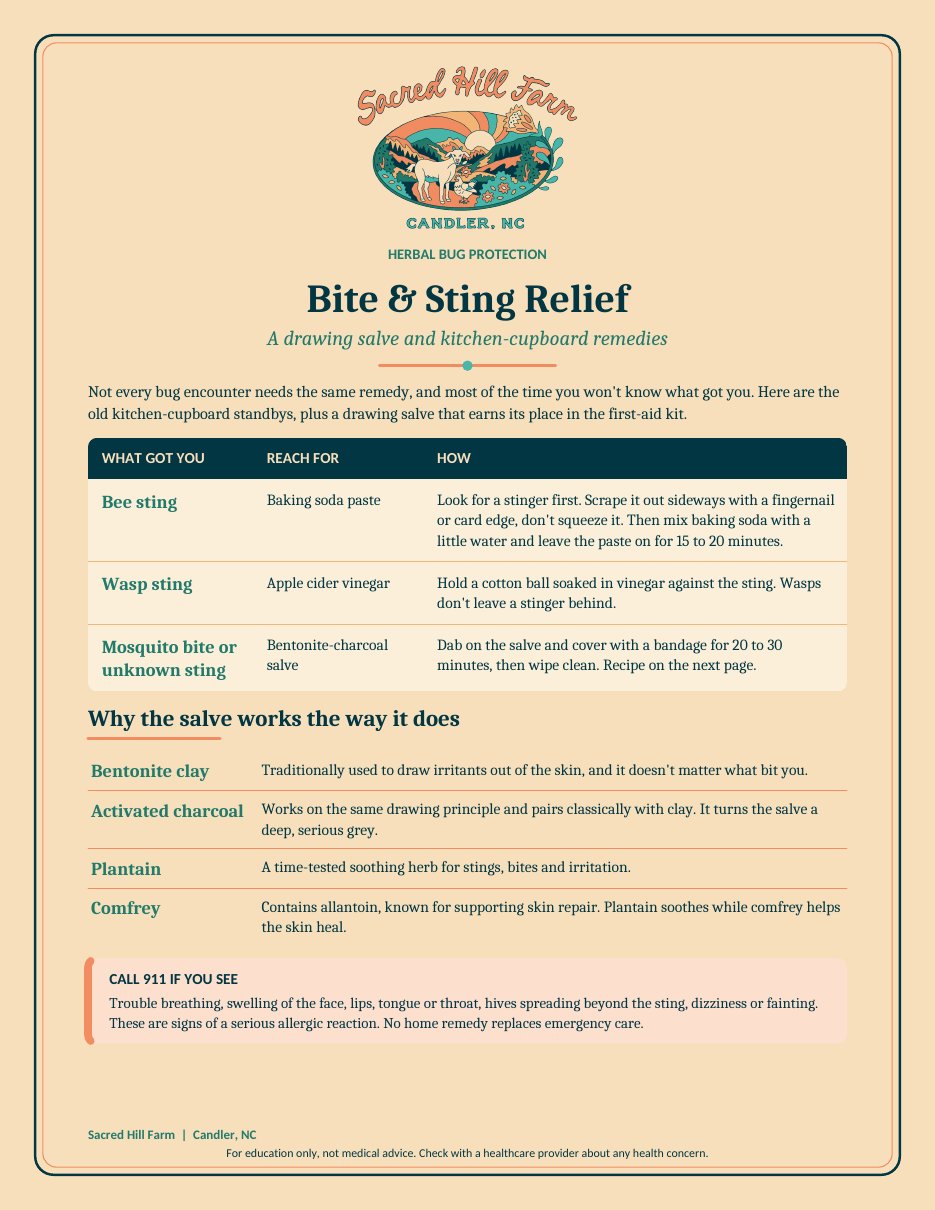
Quick reference: which remedy for which bite
| Culprit | Best remedy | Why |
|---|---|---|
| Bee sting | Baking soda paste | Neutralizes acidic venom |
| Wasp sting | Apple cider vinegar | Neutralizes alkaline venom |
| Mosquito bite / unknown sting | Bentonite-charcoal salve | Draws out irritants regardless of cause |
This is shared from our own experience and isn't medical advice. Check with a healthcare provider before using herbal remedies, especially for children, during pregnancy, or for a suspected tick-borne illness.